Mathematics, Matter, Mind, and Periodic Table
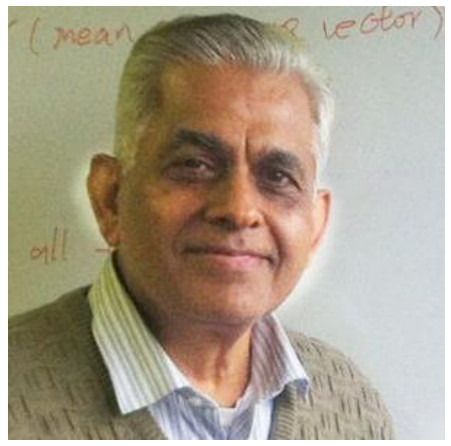 Prof. Ravindra Kulkarni is an honorary Distinguished Professor of Mathematics at Bhaskaracharya Pratishthan, Pune, India. He is a Founding Member, and presently the President of SIAA, a retired professor of Mathematics at CUNY (New York), ex-Director and Distinguished Professor at the Harish-Chandra Research Institute (Prayagraj), and a Chair Professor at IIT(Bombay). He is an ex-President of the Ramanujan Mathematical Society, and a Founding Member and ex-President of The Indian Mathematics Consortium. Besides Mathematics, he is interested in Philosophy, particularly the Indian Knowledge System, and he is an avid meditator.
We start by explaining the nature of theory-building. Roughly, a "theory" is an organization of our thoughts on accumulated data on some domain of (human) experience. We shall apply this consideration to the atomic theory in chemistry which arose as an explanation of the philosophical notion of "matter". We shall then explain the role that Mathematics has played in this theory-building. In turn, this raises the question about the nature of Mathematics. In the process, we attempt to offer a definition of Mathematics. With this background, we give a leisurely, semi-historical, introduction to the development of Chemistry, starting from Kan'aad and Democritus of antiquity, via Dalton (1803), to the Mendeleev's periodic table of atoms (1869). Dalton-Mendeleev's work was based on lab experiments. Its much better theoretical explanation came only after Rutherford's discovery of electron (1909), and the whole development up to the standard model of Quantum Mechanics (1913, 1926, 1984). We give a now-obvious mathematical definition of "period" of atoms as the natural number 8, which however is not found in Chemistry literature! More seriously, we offer a mathematical explanation of the sequence of natural numbers, 2, 10, 18, 36, 54, 86, and 118, embedded in Mendeleev's periodic table. We shall end with some speculations on the possible use of Mathematics in explaining the philosophical notion of "Mind", which we regard as "dual" to that of "Matter".
The talk is based on article published in The Mathematics Consortium Bulletin January 2022 Vol. 3, Issue 3