Food as Medicine Using Metabolomics
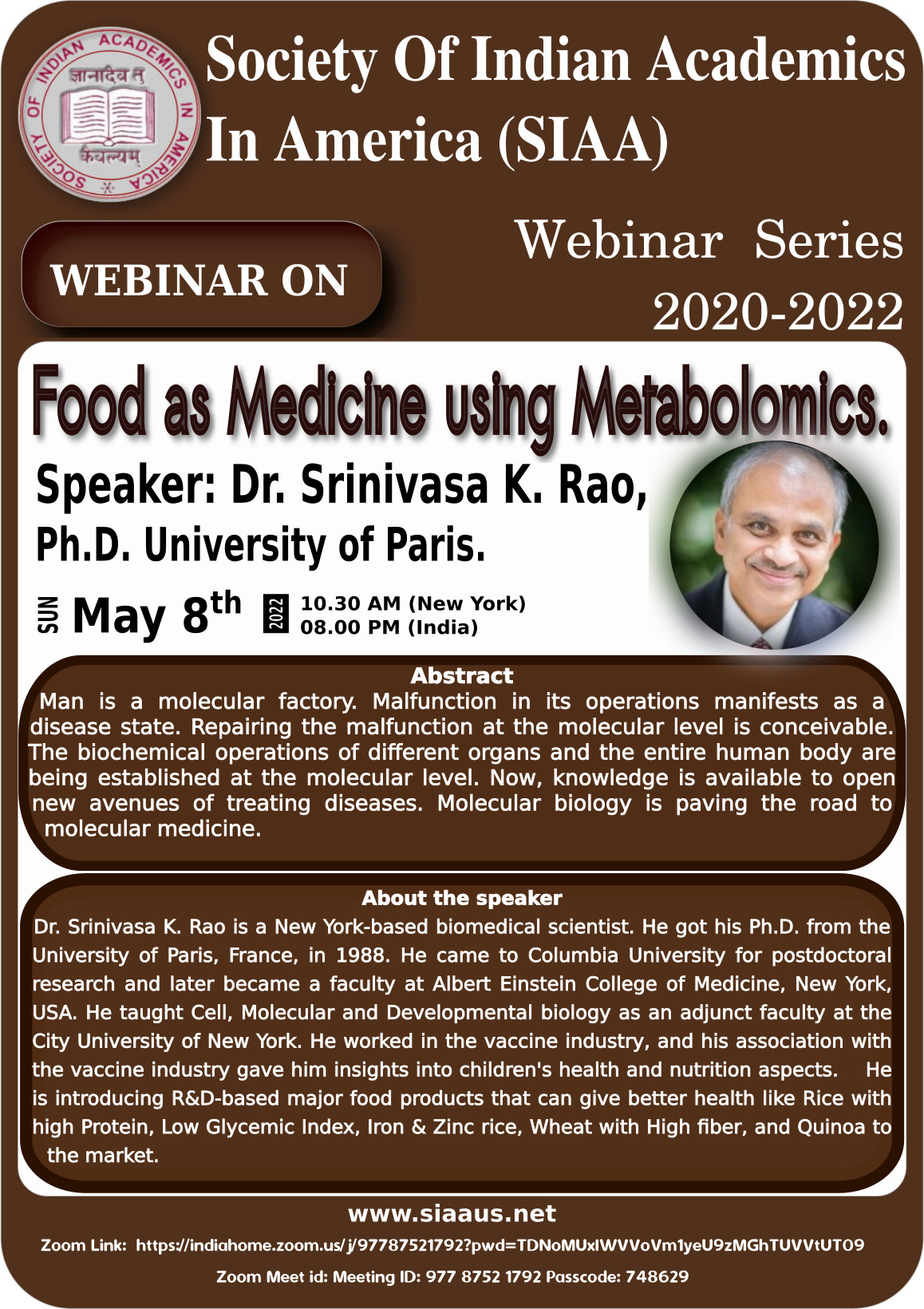
 Dr. Srinivasa K. Rao is a New York-based biomedical scientist. He got his Ph.D. from the University of Paris, France, in 1988. He came to Columbia University for postdoctoral research and later became a faculty at Albert Einstein College of Medicine, New York, USA. He taught Cell, Molecular and Developmental biology as an adjunct faculty at the City University of New York. He worked in the vaccine industry, and his association with the vaccine industry gave him insights into children’s health and nutrition aspects.
He is introducing R&D-based major food products that can give better health like Rice with high Protein, Low Glycemic Index, Iron & Zinc rice, Wheat with High fiber, and Quinoa to the market. He did several courses related to food and nutrition from Stanford, Harvard, Colorado universities of the USA, Wageningen University, Netherlands, to update his knowledge in this area. He delivered a nutrition lesson online and gained 26,000 plus views, for which India International Science Festival (IISF) 2020 received the Guinness Book of World Record.
Knowledge about food is an essential component of an Individual’s health. So, he developed charts, flashcards, puzzles, coloring book-related materials for 200 to 500 food items.
Further, he developed a game Foodpardy, (watch it from 20-45 minutes at this link – https://youtu.be/BJgO2CLl09I ). It’s a game like Jeopardy, played at IISF 2020. He’simplementing it in New York for seniors for whom knowledge about food to improve their health is critical.
He is attempting to integrate key metabolites of diseases database, Malacards, with the Human Metabolomics database and Food nutrient database to arrive at the food suggestions that can help attain and maintain a healthy state.
Man is a molecular factory. Malfunction in its operations manifests as a disease state. Repairing the malfunction at the molecular level is conceivable. The biochemical operations of different organs and the entire human body are being established at the molecular level. Now, knowledge is available to open new avenues of treating diseases. Molecular biology is paving the road to molecular medicine.
We have attempted to integrate key metabolites of diseases database, Malacards, with the Human Metabolomics database and Food nutrient database to arrive at the food suggestions that can help the disease state to have progressed towards a healthy state. Diet and nutrition are a significant part of disease management. Since ancient times Indian traditional medical system, Ayurveda, and Traditional Chinese Medicine (TCM) have been using food as the main component in the disease management plan for a number of centuries. A curated non-redundant in silico library of 9,596 phytochemicals is available in the Indian Medicinal Plants, Phytochemistry And Therapeutics (IMPPAT). Many of the 1,700 plants listed in this database are edible plants and traditional parts of food even today. Linking these databases to specific disease conditions and finding suitable food as medicine can be taken up to aid modern-day modern medicine in managing disease treatment. Metabolite identification and database linking helped to take up the Metabolic pathway and network analysis. This approach is leading to multi-omics data integration. Our results of this work in the area of cardiometabolic diseases can lead to the suggestion that the following plants have an important role in disease management.