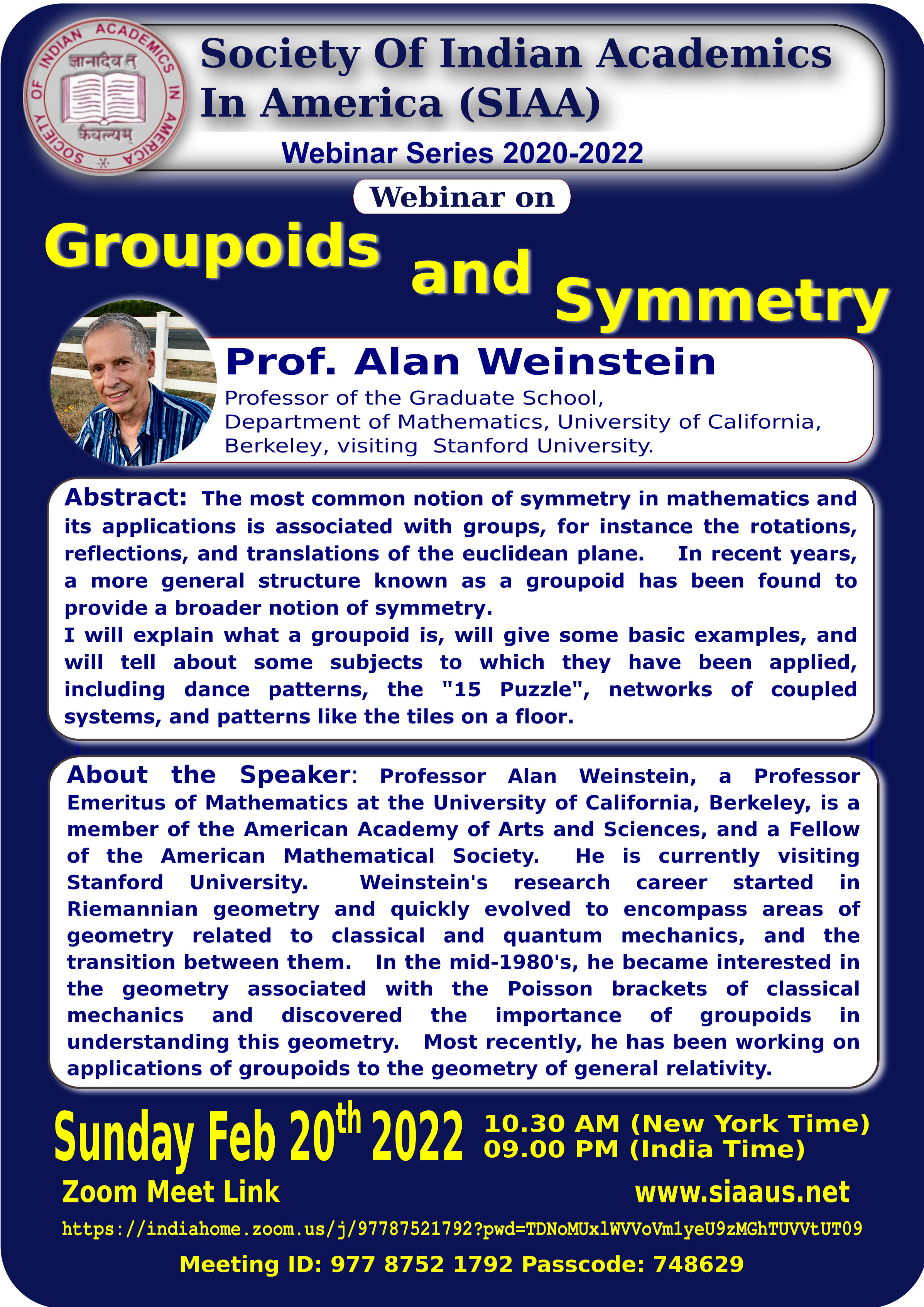
Groupoids and Symmetry
 Professor Alan Weinstein, a Professor Emeritus of Mathematics at the University of California, Berkeley, is a member of the American Academy of Arts and Sciences, and a Fellow of the American Mathematical Society. He is currently visiting Stanford University.
Weinstein's research career started in Riemannian geometry and quickly evolved to encompass areas of geometry related to classical and quantum mechanics, and the transition between them. In the mid-1980's, he became interested in the geometry associated with the Poisson brackets of classical mechanics and discovered the importance of groupoids in understanding this geometry. Most recently, he has been working on applications of groupoids to the geometry of general relativity.
The most common notion of symmetry in mathematics and its applications is associated with groups, for instance the rotations, reflections, and translations of the euclidean plane. In recent years, a more general structure known as a groupoid has been found to provide a broader notion of symmetry.
I will explain what a groupoid is, will give some basic examples, and will tell about some subjects to which they have been applied, including dance patterns, the "15 Puzzle", networks of coupled systems, and patterns like the tiles on a floor.