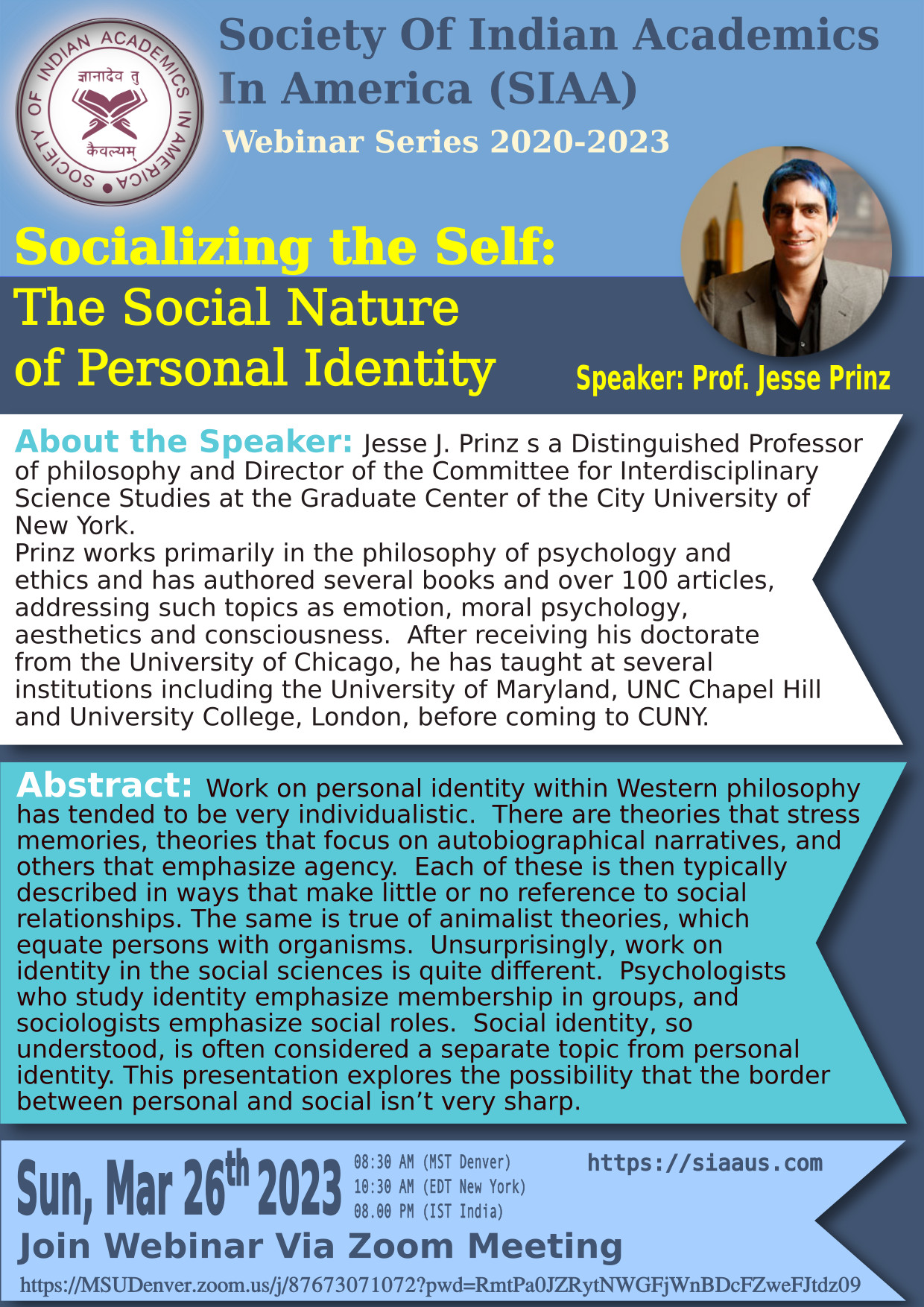
Socializing the Self: The Social Nature of Personal Identity
 Jesse Prinz is a Distinguished Professor of Philosophy at the Graduate Center of the City University of New York. However, he lives in Chapel Hill and is a Research Professor here in the Chapel Hill Philosophy Department, where he continues to work closely with graduate students and serve on thesis committees. Prinz has research interests in cognitive science, philosophy of psychology, philosophy of language, moral psychology, and aesthetics. His first three books are: Furnishing the Mind: Concepts and Their Perceptual Basis (MIT: 2002), Gut Reactions: A Perceptual Theory of Emotion (OUP: 2004), and The Emotional Construction of Morals (OUP: 2007). He also has two forthcoming titles:Beyond Human Nature (London: Penguin; New York: Norton) and The Conscious Brain (Oxford). He has published numerous articles on concepts, emotions, morals, consciousness, and other topics.
Work on personal identity within Western philosophy has tended to be very individualistic. There are theories that stress memories, theories that focus on autobiographical narratives, and others that emphasize agency. Each of these is then typically described in ways that make little or no reference to social relationships. The same is true of animalist theories, which equate persons with organisms. Unsurprisingly, work on identity in the social sciences is quite different. Psychologists who study identity emphasize membership in groups, and sociologists emphasize social roles. Social identity, so understood, is often considered a separate topic from personal identity. This presentation explores the possibility that the border between personal and social isn’t very sharp. Many aspects of personal identity have social dimensions. This is especially evident in recent work relating personal identity to values, since values are, typically socially transmitted, socially directed, and shared. Moreover, each of the aforementioned individualistic approaches is amenable to social interpretations. In each case, the personal turns out to be social. A similar lesson may apply to theories of selfhood in Indian philosophy. Theories of the self that have been developed in Nyaya and Vedanta schools may appear to be minimal in ways that resist both personal and social interpretations, but, on close examination, they too call for expansive views on which each of us is more interconnected than philosophers in the Western canon would have as believe. Likewise for no-self views in Buddhist philosophy. The idea that we are punctuate beings can be challenged from many directions. Personal identity is, evidently, social. If correct, this conclusion has methodological, metaphysical, and political implications.